

24 Aug Plate Heat Exchanger Powerful Cooling for Modern Industry
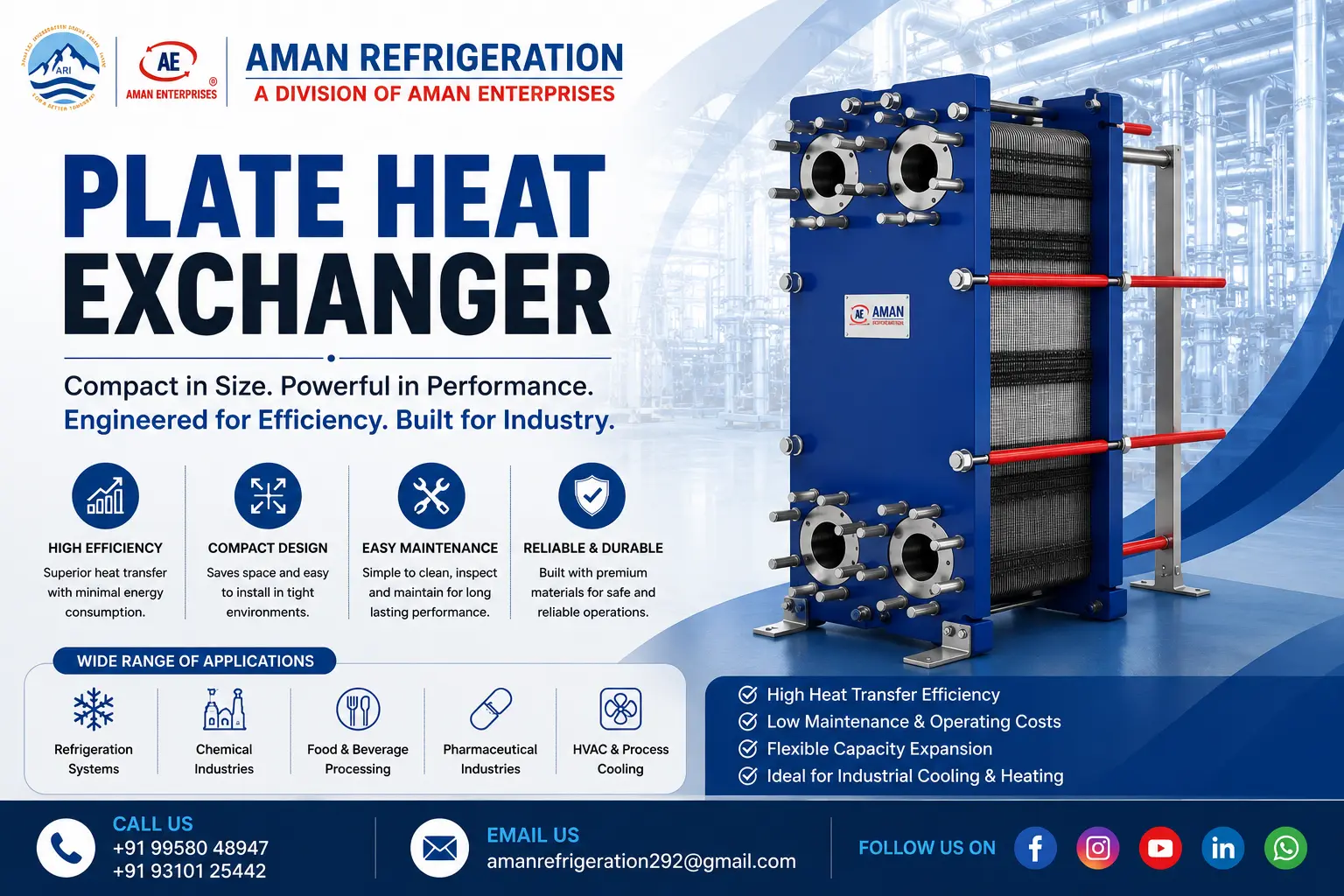
Plate Heat Exchanger is one of the most efficient ways of transferring heat from one fluid to another without mixing the fluids. Its compact design, high heat-transfer efficiency and practical maintenance advantages make it a valuable element in modern industrial cooling and heating systems. The industries are demanding for reliable and energy efficient thermal solutions and this is driving the need for advanced heat exchange technology. Aman Refrigeration offers industrial refrigeration and heat-transfer solutions designed to meet the specific needs of different applications. The company’s product portfolio consists of Plate Heat Exchangers used as condensers and evaporators in industrial refrigeration systems.
What Is a Plate Heat Exchanger?
Plate Heat Exchanger is a heat exchanger used for heat transfer between two fluids which are separated by a solid wall. It is a collection of thin metal plates specially designed and put together. These plates constitute alternate channels through which hot and cold fluids flow. As the fluids pass through different channels, the heat is transferred from the hot fluid to the cooler one through the metal plates. The fluids are not in contact with each other directly. The plates have a corrugated pattern , which makes for turbulence in the channels .
This results in improved heat transfer and enables the equipment to achieve a high thermal performance with a relatively small footprint. This design makes a Plate Heat Exchanger highly beneficial for facilities that have limited installation space but need efficient heat transfer.
How Does a Plate Heat Exchanger Work?
connections. The plates define the alternating channels through which the fluid flows. The fluids flow through these channels and the thermal energy is transferred from the hotter fluid through the plate material to the cooler fluid. The fluids do not directly come into contact with each other. For many industrial systems, counter-current flow is used because it can provide an effective temperature difference across the heat-transfer surface.
The basic process involves:
- Hot fluid entering through one connection.
- A second connection is where cold fluid enters.
- Fluid channels divided, kept separate.
- Heat passes through the metal sheets.
- Their vents for fluids leaving, cooled or heated.
This simple but very effective arrangement allows controlled temperatures to be achieved by industries while maintaining the equipment compact.
High Heat Transfer Efficiency
The thermal performance is one of the biggest advantages of a Plate Heat Exchanger. The plates provide a large area for heat transfer in a compact physical space. They also have corrugations which cause the fluid to flow turbulently helping with effective heat transfer.
This combination allows businesses to reach the needed thermal performance without necessarily requiring the large footprint of some traditional heat-exchange arrangements. Better heat transfer in industrial facilities results in better system performance and more controlled operating conditions. Efficiency is particularly important in facilities where refrigeration and cooling systems operate for long hours.
Why Industries Choose Plate Heat Exchangers
Industry operations are always looking for ways to be more efficient, but not at the expense of reliability. Plate Heat Exchanger has many practical benefits.
- Heat transfer with high efficiency
The corrugated plate design creates turbulence and also provides a large area for heat transfer.
Improved heat transfer will increase system performance and provide better temperature control for refrigeration and process cooling applications. - Compact ConstructionSpace is often an important consideration inside industrial plants. Plate heat exchangers can give a very large amount of heat transfer in a very small amount of installation space. This makes them useful in facilities where equipment space is at a premium, or where existing systems need to be upgraded without major structural changes.
- Easy Cleaning and MaintenanceMaintenance is an important part of industrial refrigeration.Some designs of plate heat exchangers can be opened for inspection and cleaning. When needed, plates can be removed to enable maintenance teams to inspect internal surfaces and deal with deposits or fouling. Easy cleaning and maintenance is one of the important benefits of Aman Refrigeration’s plate heat exchanger solutions.
- Flexible CapacityIndustrial requirements can change over time.In suitable gasketed designs, additional plates can sometimes be added to increase heat-transfer capacity. This provides useful flexibility when production requirements increase.Any change should thus be checked by qualified engineers to verify that the resulting configuration satisfies the necessary requirements for thermal, pressure, material and safety.
- Reduced Installation FootprintThe equipment can provide substantial thermal performance from a small footprint which can ease integration into existing industrial plants. This can be especially useful for refrigeration rooms, process plants, HVAC installations and manufacturing facilities. helping engineers realize more use of the available plant space.
Key Factors to Consider Before Selecting a Plate Heat Exchanger
Things to Consider Before Choosing a Plate Heat Exchanger The choice of the proper equipment is more complicated than the choice of a heat transfer surface.
The key things to consider are:
- Heat-transfer duty. Calculate the amount of thermal energy that must be transferred.
- Fluid type List the fluids and their chemical properties.
- Flow rate Thermal and hydraulic calculations require correct flow information. Inlet and
- outlet temperatures These values determine the heat transfer area required
- Operating pressure The selected unit shall be able to operate safely at the system pressure.
- Operating temperature The materials and seals should be compatible with the temperature range.
- Material compatibility The plate and gasket materials should be compatible with the process conditions.
- Pressure drop A pressure drop that is too high increases pumping and system energy requirements.
- Maintenance requirements Look at cleaning access and service requirements.
- Available installation space Compact equipment can be particularly valuable in retrofit projects.
A good design of selection is a compromise between thermal performance, pressure drop, reliability, maintenance and other operational requirements. Pharmaceuticals
The production and storage of pharmaceuticals require stringent temperature control.
If well-designed, the Plate Heat Exchanger can be a reliable source of thermal management where stability of process and accuracy of temperature are important.
The equipment can be incorporated in cooling and heating systems for pharmaceutical production and associated facilities.
Chemical and Process Industries
In many chemical processes large amounts of heat are evolved or required. Efficient thermal exchange helps regulate process temperatures, protect equipment and improve plant performance. Particular importance has the selection of the appropriate materials when the fluids involved are chemically aggressive.
HVAC and Commercial Cooling
Plate heat exchangers are also used in HVAC and building cooling. They have a compact construction which makes them attractive for areas where the available space for equipment is limited but an efficient heat transfer is necessary. Depending on project requirements, they can be integrated in chilled-water and process-cooling systems.
Plate Heat Exchanger as Condenser and Evaporator
In refrigeration applications the heat exchangers can have different purposes, depending on the design of the system. The equipment can be used as a condenser to remove heat from refrigerant and help with the condensation process. As an evaporator, it can contribute to heat absorption from the process fluid or cooling medium. The exact configuration depends on the refrigeration cycle, the refrigerant, the operating temperatures, the pressure conditions, the fluid properties and the required capacity.
Important Factors When Selecting a Plate Heat Exchanger
Selecting the proper equipment is not just a matter of picking a specific size. The first thing engineers have to evaluate is the thermal load. Flow rate is also important, because it affects pressure drop and heat-transfer performance. To establish the required heat-transfer area, the temperature difference between the fluids must be taken into account. The fluid properties are important too. Viscosity, density, corrosivity, fouling potential, and the pressure within the system can all affect the equipment selection. The compatibility of materials also needs to be carefully evaluated, especially for chemical, food, pharmaceutical and specialty industrial applications.
Finally, the physical layout of the plant should be considered. A compact system may be particularly valuable where installation space is restricted.
The Aman Refrigeration Approach
Aman Refrigeration is a specialist in industrial refrigeration and cooling for numerous applications. The product portfolio consists of ammonia refrigeration units, Freon air- and water-cooled refrigeration units, low-charge refrigeration skids, evaporative condensers, closed-loop cooling towers, Plate Heat Exchangers, pressure vessels, mechanical pump recirculation systems, air cooling units and automation and control panels.
Aman Refrigeration is committed to compact construction, thermal efficiency, maintainability and reliable performance for Plate Heat Exchanger applications. The company also says its heat exchangers are suitable for use in the food and beverage, pharmaceutical, manufacturing, chemical and petrochemical industries. This larger industrial refrigeration capability can be useful when a customer needs more than a single component and needs a coordinated cooling solution.
Why Engineering and Customization Matter
Each industrial refrigeration project has different operating conditions. A standard heat exchanger is not always the best solution for a particular application. Final selection should be based on engineering considerations such as required capacity, fluid type, operating temperature, pressure, flow rate, material, connection size and available installation area. Customization can help ensure that the equipment will operate efficiently as part of the larger refrigeration or process-cooling system.
This is especially true for industrial projects where equipment is constantly running and even small performance limitations can affect production efficiency.
Conclusion
A Plate Heat Exchanger is not merely a heat-transfer element. Compact structure, high thermal efficiency, flexible configuration and maintenance advantages make it an important solution in modern industrial cooling and refrigeration applications. Efficient heat transfer enables companies to operate within close parameters and increase system performance. This is critical in food processing, cold storage, pharmaceuticals, chemical processing, HVAC and manufacturing. Aman Refrigeration offers Plate Heat Exchanger solutions for challenging applications.
For businesses needing dependable industrial refrigeration and heat transfer solutions. A well engineered, well designed and sized heat exchanger, made of the right materials and properly installed and maintained can be a valuable component of an efficient and reliable industrial cooling system. To learn more about industrial refrigeration and Plate Heat Exchanger solutions please contact Aman Refrigeration and discuss your application requirements with their technical team.
No Comments