


19 Nov Ammonia Chiller Service and Repair in India: 7 Warning Signs You Shouldn’t Ignore
7 Warning Signs You Need Ammonia Chiller Service and Repair
Ammonia chillers run for long hours in dairies, breweries, cold stores and food plants. Small faults can grow quietly until a sudden shutdown puts stock, power bills and worker safety at risk. That is why knowing the basics of Ammonia Chiller Service And Repair helps plant owners act early instead of waiting for a breakdown.
A change in sound, pressure, temperature or power use often shows that something needs checking.
In this, we explain seven common warning signs, what may cause them, and what to check before choosing Ammonia Chiller Service And Repair.
What Is an Ammonia Chiller?
What is an ammonia refrigerator called?
In industry, it is called an ammonia refrigeration plant, or an ammonia chiller when it cools water or brine. It is known as an R717 system. Ammonia is a natural refrigerant with strong cooling power. It is toxic and works at high pressure, so Ammonia Chiller Service And Repair must be done by trained technicians only.
- Rising Electricity Bills
If your power bill goes up while production stays the same, the chiller may be working harder than it should. Dirty or scaled Condensers, worn valves or air in the system can all increase energy use.
What should you do?
Compare monthly power use with production. A steady rise is a good reason to book Ammonia Chiller Service And Repair. - Unusual Noise or Vibration
Knocking, grinding or new vibration can point to worn bearings, loose mounts or liquid reaching the compressor.
What should you do?
Do not ignore a new sound. Ask for Ammonia Chiller Service And Repair before a small fault becomes major damage. - Oil Leaks or Oil in the Wrong Place
Oil should stay inside the compressor and oil system. Oil around joints, seals or the compressor base can mean a leaking seal or gasket. Poor oil management can also damage bearings.
What should you do?
Wipe the area, note where the oil returns, and share this when booking Ammonia Chiller Service And Repair. - Frost or Ice Where It Should Not Be
Some frosting is normal on evaporators. Heavy ice on suction lines, valves or only one part of the coil can show a flow problem, a defrost fault or poor control settings.
What should you do?
Check your defrost cycle, then arrange Ammonia Chiller Service And Repair for the coil and valves. - High Discharge Pressure or Low Suction Pressure
High discharge pressure often links to dirty condensers or poor heat rejection. Low suction pressure can come from restricted flow or low refrigerant levels.
What should you do?
Record daily readings. Sudden changes matter more than a single number, so share the log during Ammonia Chiller Service And Repair. - Rooms or Products Not Reaching the Set Temperature
When a cold room or process line drifts above the set temperature, product quality is at risk. Causes can include a fouled evaporator, a faulty sensor, a control problem or a system that is too small for the load.
What should you do?
Check door seals and loading patterns first, then call for Ammonia Chiller Service And Repair. A single Control panel fault can look like a cooling problem. - Ammonia Smell or Leak Alarm
This is the most serious sign. A sharp smell or a gas detector alarm means ammonia may be escaping.
What should you do?
Leave the area, follow your plant’s emergency plan and call trained responders. Never try to find or fix a leak yourself; Ammonia Chiller Service And Repair needs trained staff and protective equipment.
Warning Sign, Possible Cause and Action
| Warning Sign | Possible Cause | Suggested Action |
|---|---|---|
| Rising power bills | Dirty condenser, worn parts | Book an inspection |
| Noise or vibration | Bearing wear, loose parts | Check compressor |
| Oil leaks | Seal or gasket wear | Locate and repair leak |
| Heavy frost | Defrost or flow fault | Inspect coil and valves |
| Pressure changes | Fouling, restricted flow | Review pressure log |
| Temperature drift | Sensor, evaporator or control fault | Test sensors and controls |
| Ammonia smell | Leak | Evacuate and call responders |
These causes are common, but only a proper inspection can confirm the real one.
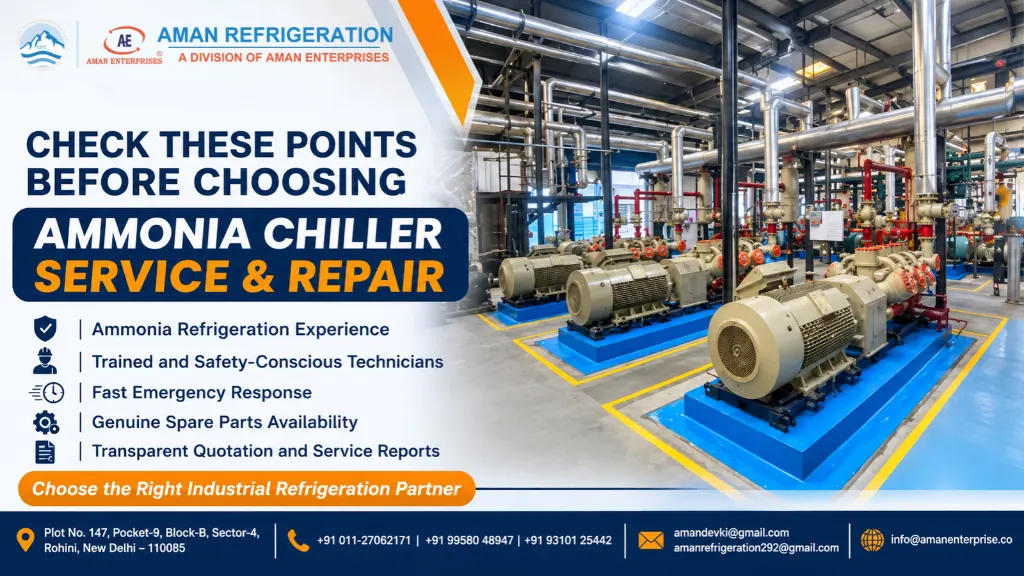
Check These Points Before Choosing Ammonia Chiller Service and Repair
- Ammonia experience: Ask for similar projects, not only Freon work.
- Trained technicians: Staff must know ammonia safety procedures.
- Response time: Fast support matters when stock is at risk.
- Spare parts: Valves, seals and gauges should be easy to source.
- Clear quotes: Ask for a written scope, price and report format.
- System knowledge: A company that designs and builds plants can find faults faster.
- Documentation: Look for checklists, readings and advice after every visit.
How Aman Refrigeration Supports Industrial Plants
Aman Refrigeration Private Limited, an associate company of Aman Enterprises, was founded in 2013 to build chillers and industrial cooling systems, mainly for the food and beverage industry. The product range includes:
- Ammonia Refrigeration Units
- Low Charge Refrigeration Skids
- Pressure Vessels
- Mechanical Pump Recirculation Systems
- Freon Air & Water Cooled Units
Because the team works across these systems, Ammonia Chiller Service And Repair can cover your whole plant in one place.
Conclusion
Rising power bills, strange noises, oil leaks, heavy frost, pressure changes, temperature drift and ammonia smells are all signals worth acting on. The earlier you respond, the lower the risk to your product, your budget and your people.
If your chiller shows any of these signs, contact Aman Refrigeration for Ammonia Chiller Service And Repair.
FAQ's
What is an ammonia refrigerator called?
It is called an ammonia refrigeration plant or ammonia chiller, also known as an R717 system.
How often should I book ammonia chiller service and repair?
Daily operator checks, regular inspections and a full yearly service are a good starting point. Follow your plant’s usage and the manufacturer’s guidance.
Can ammonia chiller service and repair be done while the plant runs?
Some inspections can. Opening lines, vessels or valves needs a planned shutdown and strict safety steps.
No Comments