

24 Nov Low Charge Ammonia Refrigeration System: 2027 Trend Guide
Low Charge Ammonia Refrigeration System: Is Worth It?
A Low Charge Ammonia Refrigeration System is a compact, packaged ammonia plant that holds far less refrigerant than a traditional ammonia plant. It keeps the efficiency of ammonia but lowers the risk if a leak happens. It suits cold stores, food plants and process cooling where safety, space and compliance matter.
Planning a new plant or replacing an old one? Send your load and location to our team for a recommendation.
What Is a Low Charge Ammonia Refrigeration System?
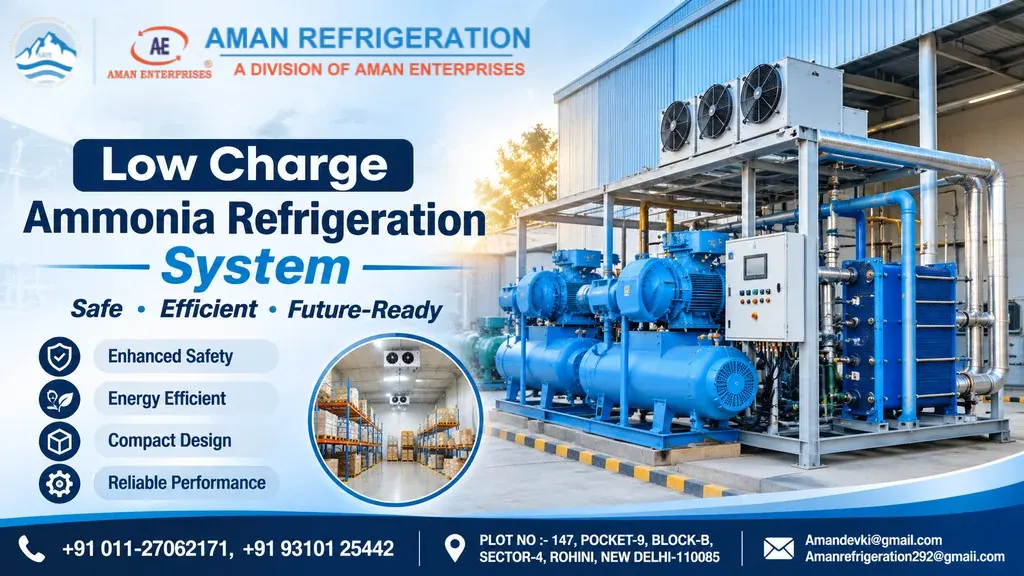
Ammonia (R717) is a natural refrigerant with strong cooling performance. In a traditional plant, a large amount of liquid ammonia sits in vessels, pipes and evaporators across the site. A Low Charge Ammonia Refrigeration System cuts that inventory by keeping the ammonia in a compact skid and using chilled glycol or brine to carry cooling to the process. Our Low-Charge Refrigeration Skids follow this approach.
There is no single worldwide definition of “low charge”. One industry guideline, IIAR’s ARM-LC, covers systems holding 500 lb (227 kg) of ammonia or less. Always ask a supplier for the actual charge in kg.
How Does a Low Charge Ammonia Refrigeration System Work?
The idea is simple: keep the ammonia where it is needed and nowhere else.
- Compact ammonia circuit: The compressor, condenser and heat exchanger sit together on one skid.
- Secondary fluid: Chilled glycol or brine carries the cooling to air cooling units or process equipment.
- Controls: Sensors and an automation and control panel manage pressure, flow and safety trips.
Some designs use direct expansion or other feed methods to cut the charge further. Each has trade-offs, so match the design to your process.
Why Is the Low Charge Ammonia Refrigeration System a Trend?
Industry press names low-charge designs as a leading shift in ammonia refrigeration, and reports that packaged and field-built versions are increasingly chosen for new installations. Safety is a main driver. A small ammonia inventory makes a release that affects people outside the site very unlikely.
Tighter rules on refrigerant inventory also push plants toward smaller charges. Owners of old R22 plants are another group, because they must replace their equipment anyway.
For Indian plants, check which safety and licensing rules apply to your site and charge size.
Benefits of a Low Charge Ammonia Refrigeration System
- Lower leak risk: Less ammonia on site means less to release.
- Packaged build: A factory-built skid arrives tested and needs less site work.
- Natural refrigerant: Ammonia has zero ozone depletion potential. See our eco-friendly engineering.
- Simpler piping: Less ammonia pipework runs through the building.
- Modular growth: Plants add skids as load grows. A Low Charge Ammonia Refrigeration System often uses several parallel units, each of roughly 5 to 60 TR.
- Competitive cost: One manufacturer reports installed cost can match site-built plants, and can fall further when air-cooled condensers remove water piping.
Low Charge vs Traditional Ammonia vs Freon
| Point | Low Charge | Traditional Ammonia | Freon Chiller |
|---|---|---|---|
| Refrigerant Amount | Small, packaged | Large, site-wide | Moderate |
| Leak Consequence | Lower | Higher | Lower toxicity, high GWP |
| Site Work | Less | More | Less |
| Best For | New cold stores, process cooling | Very large plants | Smaller duties |
No type wins every time. Large cold stores may suit a traditional Ammonia RefrigerationUnit,
and smaller loads may suit a Freon Air or Water-Cooled Unit. Choosing a low charge ammonia refrigeration system depends on your load, location and budget.
Where a Low Charge Ammonia Refrigeration System Fits Best
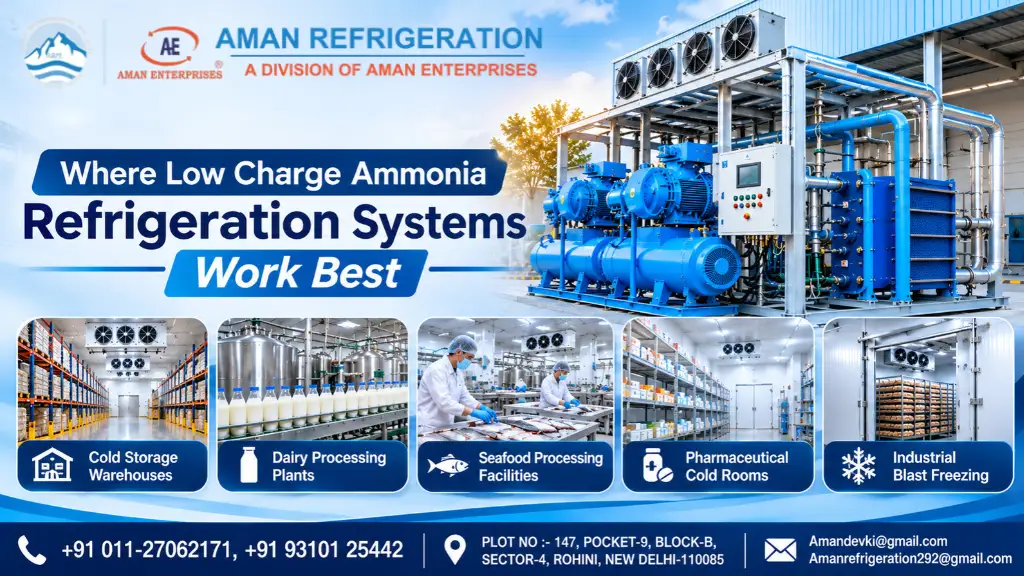
- Cold storage and warehouses
- Dairy, meat, seafood and beverage plants
- Blast freezing, see our Commercial Blast Freezers
- Food and pharma plants wanting a smaller ammonia inventory
- Replacement of ageing R22 plants
Each of these sites has the same need: a safe, compact plant that is easy to service. A low charge ammonia refrigeration system meets that need when it is sized for the real load, so share your product, temperature and daily throughput before you ask for a quote.
Limits to Know
- Not for every load: Very large capacities may need several skids.
- Skilled service still needed: Ammonia needs trained operators and a maintenance plan, even at low charge. Our Service team can help.
- Design quality matters: Efficiency depends on controls, condenser choice and heat exchanger sizing, not on the label. A matched Evaporative Condenser and Plate Heat Exchanger help.
- Claims need proof: Ask for energy data from a running plant, not a brochure.
How to Choose a Low Charge Ammonia Refrigeration System
Ask these questions before you order:
- What is the total ammonia charge, in kg, for my capacity?
- What capacity does each skid deliver, and how can the plant expand?
- Which condenser type is used, and how much water does it need?
- What safety devices and leak detection are included?
- What controls and remote monitoring are offered?
- Can I see a reference plant and its measured energy use?
- Who provides commissioning, training and AMC support?
For one team to handle design, supply and commissioning, see our Turnkey Solution. For an independent design review, see our Consultancy solution.
Conclusion
A Low Charge Ammonia Refrigeration System gives plant owners the efficiency of ammonia with a smaller inventory and a safer profile. It is a strong choice for new cold stores, food plants and R22 replacements, provided the design, charge and service plan are right. Aman Refrigeration can help you size a low charge ammonia refrigeration system for your load. Contact us today to start your project planning.
Call +91 99580 48947 or +91 93101 25442, or Send your capacity, Product and location for a project quote.
No Comments